
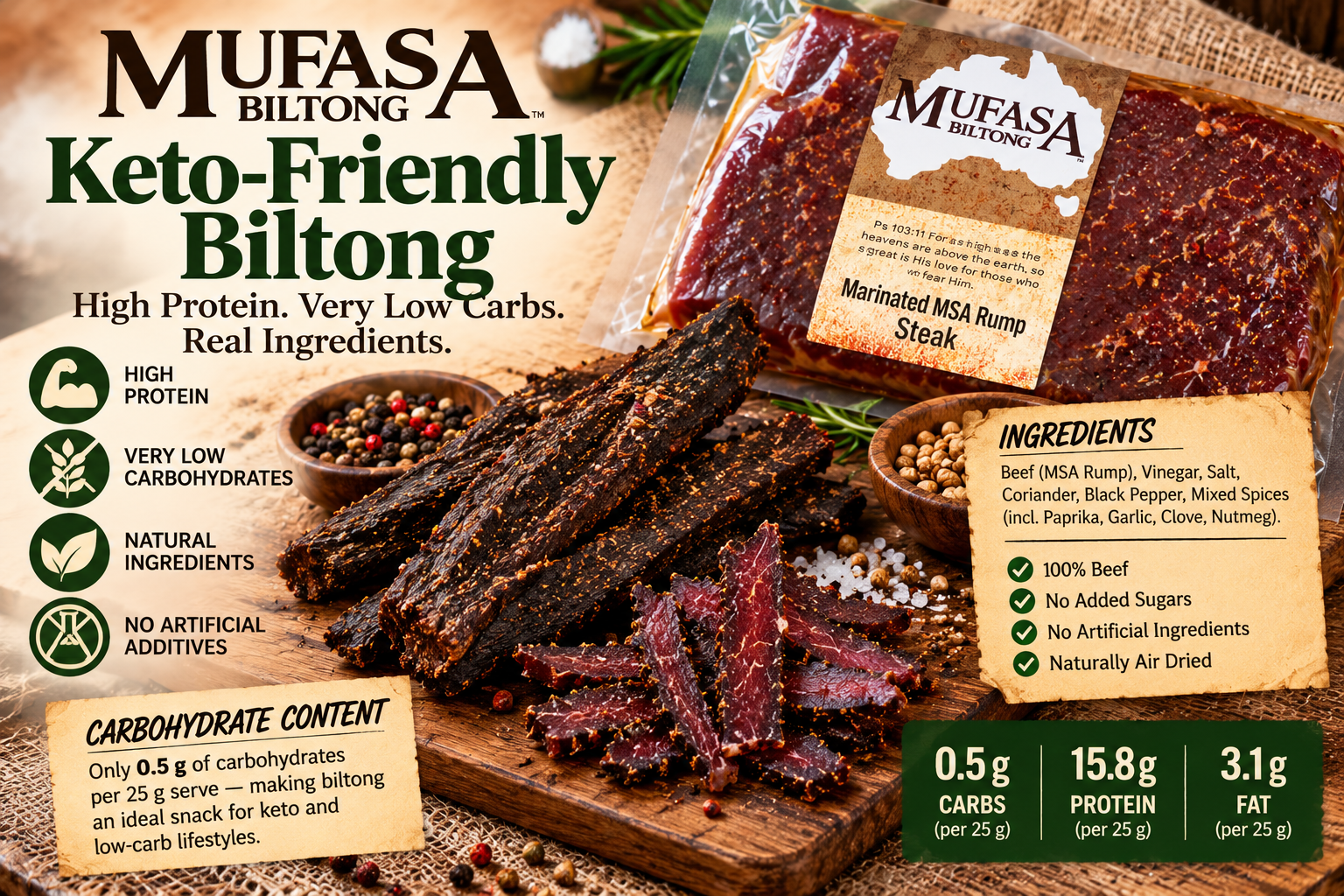
Introduction: Is Biltong Suitable for a Keto Diet?
Finding convenient snacks can be challenging when you follow a ketogenic diet. Many familiar options contain significant amounts of carbohydrates, added sugar or starch, making it important to check labels before adding them to your shopping basket. This is where keto-friendly biltong may be worth considering.
Biltong is a traditional dried meat snack commonly made from beef, vinegar, salt and seasonings. Because it is meat-based, many varieties provide protein while containing relatively few carbohydrates. However, not every product has the same nutritional profile. Some recipes include sugar, sweetened marinades or other ingredients that increase the carbohydrate content.
Choosing keto-friendly biltong starts with understanding how its carbohydrate content, ingredients and serving size fit into your daily eating plan. By understanding the nutrition information panel, checking the ingredient list and paying attention to serving sizes, you can make a more informed decision.
In this guide, we explain seven practical label checks to help you compare biltong products and decide which options best fit your eating preferences.
How to Choose Keto-Friendly Biltong by Reading the Label
When comparing keto-friendly biltong, look beyond the product name and check the nutrition information panel. Compare carbohydrates per 100 grams, review the ingredients for added sugar, and consider sodium and protein. These details help you make a more informed choice based on your own carbohydrate target and dietary preferences.
1. Check the Total Carbohydrates First
Carbohydrates are one of the most important details to examine when choosing biltong for a ketogenic eating plan. Keto diets generally restrict carbohydrate intake to encourage the body to use fat as a primary energy source, although individual carbohydrate limits vary.
Start by locating the carbohydrate information on the nutrition information panel. In Australia, packaged foods generally display nutrient information per serving and per 100 grams, making it easier to compare products.
For example, imagine two hypothetical biltong products:
- Product A: 2 g of carbohydrates per 100 g.
- Product B: 9 g of carbohydrates per 100 g.
Product A contains fewer carbohydrates for the same weight. If carbohydrate restriction is a priority for you, this difference may influence your choice.
However, do not compare products using only the serving-size column. Manufacturers may define different serving sizes, which can make one product appear lower in carbohydrates simply because the suggested portion is smaller.
Use the per-100-gram figures to compare products fairly, then calculate the amount you would actually eat.
It is also worth remembering that a food being low in carbohydrates does not automatically mean it suits every keto plan. Your overall daily carbohydrate intake, portion sizes and other foods still matter.
2. Look for Added Sugar in the Ingredients
Sugar is another important consideration when shopping for keto-friendly biltong. Traditional-style recipes may rely on meat, vinegar, salt and spices, but commercial products can differ in their ingredients.
Some manufacturers add sugar to marinades or seasoning blends. Depending on the recipe and quantity used, this can increase the product’s carbohydrate content.
Check the ingredients list for terms such as:
- Sugar
- Dextrose
- Glucose
- Honey
- Syrups
- Other sweetening ingredients
These ingredients do not automatically make a product unsuitable for everyone, but they are worth investigating if you are trying to minimise carbohydrates.
In Australia, ingredients are generally listed in descending order by weight when they are added to a food. An ingredient appearing near the beginning of the list is therefore usually present in a greater amount than one appearing near the end.
Still, the ingredient list alone cannot tell you the exact amount of sugar in a serving. Use it alongside the nutrition information panel.
Also, remember that the sugar figure on a nutrition panel and the total carbohydrate figure are not interchangeable. Sugar is included within total carbohydrates, so check both where the information is provided.
3. Compare the Protein Content
Protein is one reason dried meat snacks appeal to people following a low-carbohydrate eating plan. Biltong can provide a concentrated source of protein because much of the moisture is removed during drying.
Protein contributes to the growth and maintenance of muscle and can help make a snack feel satisfying. However, the amount varies depending on the cut of meat, moisture level, processing method and recipe.
When comparing products, look at the protein value per 100 g first. Then consider the protein you will obtain from a realistic serving.
For example, if a product contains 50 g of protein per 100 g, a 25 g portion would provide approximately 12.5 g of protein. This is a simple calculation, not a claim about any particular brand.
Do not assume that the product with the highest protein figure is automatically the best choice. You should also consider carbohydrate content, sodium, ingredients and the amount you intend to eat.
A balanced approach is more useful than choosing a snack based on a single number. One advantage of comparing keto-friendly biltong products side by side is that you can see how much their nutritional profiles differ. Two varieties may look similar but contain different amounts of carbohydrates, protein and sodium. Compare the figures per 100 grams first, then calculate what you would consume in your usual portion.
Biltong can contribute to your daily protein intake, but it should not be your only protein source. A varied diet that includes other suitable foods can help you meet your wider nutritional needs.
4. Check Sodium and Salt Levels
Salt plays an important role in biltong production, including flavour development and preservation. As a result, some varieties can contain substantial amounts of sodium.
Sodium is an essential mineral, but regularly consuming too much can contribute to high blood pressure in susceptible people. This makes the sodium figure worth checking, especially if you eat dried meat frequently.
On Australian nutrition panels, sodium is generally listed in milligrams. Compare the amount per 100 g between products, then calculate the amount in the portion you are likely to eat.
For example, a 30 g portion contains approximately 30% of the sodium listed per 100 g. If a product lists 1,000 mg of sodium per 100 g, a 30 g portion would provide about 300 mg.
This calculation helps you understand what a snack contributes to your daily intake.
If you are watching your sodium intake, look for products with lower figures where available. Keep in mind that a product marketed as low carbohydrate or keto-friendly is not necessarily low in sodium.
You can find general information about food labelling and nutrition panels through Food Standards Australia New Zealand (FSANZ).
5. Read the Full Ingredients List
A short ingredients list can make a product easier to assess, particularly if you are trying to avoid added sugar or specific ingredients. Nevertheless, the length of the list alone does not determine whether a product is suitable for your diet.When selecting keto-friendly biltong, check whether the ingredient list includes sugar, dextrose, syrups or other carbohydrate-containing additions. Their presence does not automatically determine whether the product fits your diet, so use the ingredients list alongside the total carbohydrate figure on the nutrition panel. Always check the current product packaging because recipes can vary.
Start by checking the main ingredients and seasonings. Depending on the recipe, biltong may contain beef, vinegar, salt, spices and other flavouring ingredients.
Pay particular attention to:
- Sugar and sweeteners: These may increase carbohydrate content.
- Marinades and flavourings: Recipes vary, so check their contribution to the overall product.
- Starches or carbohydrate-containing additions: These may affect the nutrition profile.
- Allergen information: Check warnings and ingredient declarations relevant to your needs.
If you prefer a simple recipe, choose a product whose ingredients you understand and are comfortable eating.
Do not assume that words such as “natural,” “traditional” or “premium” mean a product is low in carbohydrates. Marketing descriptions are not a substitute for the nutrition panel.
Similarly, a short ingredient list does not guarantee that a product is low in sodium or suitable for every dietary requirement. Evaluate the complete label rather than relying on one feature.
6. Understand Serving Sizes and Net Carbohydrates
Even a product with a low carbohydrate figure can contribute to your daily total if you eat a large quantity. Portion awareness is therefore an important part of choosing keto-friendly biltong.
Imagine a biltong product containing 4 g of carbohydrates per 100 g. A 25 g serving would provide approximately 1 g of carbohydrates. Eating 75 g would provide approximately 3 g, assuming the nutrition values remain proportional.
This is why it helps to distinguish between the amount listed per 100 g and the amount in your actual snack.
Some people following keto diets also calculate net carbohydrates by subtracting dietary fibre from total carbohydrates. However, the approach can depend on the food’s labelling system and the ingredients involved. Do not automatically subtract sugar alcohols or other ingredients without understanding how they are counted and how they affect you.
For Australian products, start with the total carbohydrate figure displayed on the nutrition information panel. If you use a particular tracking method, apply it consistently and make sure you understand what the numbers represent.
A practical tip is to portion your biltong into a small container rather than eating directly from a large packet. This makes it easier to estimate your intake and keep track of carbohydrates, protein and sodium.
7. Consider the Whole Product, Not Just Its Keto Appeal
The final check is to look at the overall nutritional profile and how the product fits into your usual eating habits.
A snack can be low in carbohydrates yet still be high in sodium. Another product might provide plenty of protein but contain added sugar or ingredients you prefer to avoid.
Before buying, ask yourself:
- Does the carbohydrate content fit my eating plan?
- Is the protein amount useful for my needs?
- Is the sodium level appropriate for how often I eat it?
- Am I comfortable with the ingredients?
- Can I manage the portion size?
- Does the product suit my taste and texture preferences?
You should also consider storage instructions, the packaging condition and the use-by date. Follow the manufacturer’s directions for storage after opening, and do not assume that every dried meat product can be stored in the same way.
If you have a medical condition that requires dietary restrictions, or you are unsure whether a ketogenic diet is appropriate for you, seek advice from a qualified healthcare professional or accredited practising dietitian.
How to Choose Biltong for Your Keto Shopping List
Once you know what to check, comparing products becomes much easier. You do not need to memorise every nutritional figure or spend a long time in the supermarket aisle.
Instead, use a simple routine: compare total carbohydrates per 100 g, review the ingredients for added sugars, check protein and sodium, and calculate the nutritional contribution of your usual portion.
For regular shoppers, keeping a note of the products you prefer can also save time. Record the carbohydrate and sodium figures, serving size and any ingredients you want to avoid. When the recipe or packaging changes, review the label again rather than relying on an old entry.
You can explore the range available at Mufasa Biltong and use these checks to assess individual products. Always refer to the current packaging for the most accurate nutrition and ingredient information.
Remember that different biltong varieties can have different recipes and nutritional values. Do not assume that every flavour or cut has the same carbohydrate, protein or sodium content.
Frequently Asked Questions
Is biltong keto-friendly?
Many biltong varieties are relatively low in carbohydrates and provide protein, so they may fit into a ketogenic eating plan. However, the carbohydrate and sugar content varies by product. Check the current nutrition information panel and ingredients before choosing.
Does biltong contain sugar?
Some biltong products contain added sugar, while others may not. Check the ingredients list for sugar, dextrose, glucose, honey and similar ingredients. Use the nutrition panel to understand the total carbohydrate and sugar content.
How much biltong can I eat on keto?
There is no single serving size that suits everyone. It depends on the product’s nutritional values, your daily carbohydrate target, sodium intake and overall eating plan. Measure a portion and calculate its contribution rather than relying on a general rule.
Is biltong better than other keto snacks?
That depends on your needs and preferences. Biltong can offer protein with relatively few carbohydrates, but some varieties are high in sodium. Compare it with other snacks based on nutrition, ingredients, convenience and portion size.
What should I look for when buying keto-friendly biltong?
When buying keto-friendly biltong, compare total carbohydrates per 100 grams, check for added sugars, review the sodium level and read the full ingredients list. Then calculate the nutritional contribution of your intended serving to see whether it fits your personal eating plan.
Can I eat biltong every day?
Whether daily consumption is appropriate depends on the product and your overall diet. If you eat it frequently, pay attention to sodium and portion sizes, and include a variety of other foods in your diet.
Final Thoughts
Choosing keto-friendly biltong starts with understanding the label rather than trusting the product name or marketing claims. Compare carbohydrates per 100 g, look for added sugar, assess protein and sodium, and check the full ingredients list.
Serving size matters too. A product may fit your carbohydrate goals in a small portion but contribute considerably more when eaten in larger quantities.
With these seven checks, you can make more informed comparisons and choose biltong that suits your dietary preferences. Take a moment to read the packaging before buying, and remember that recipes can differ between products and change over time.
Ultimately, the best keto-friendly biltong is one whose carbohydrate content, ingredients, sodium level and serving size suit your individual dietary preferences.