
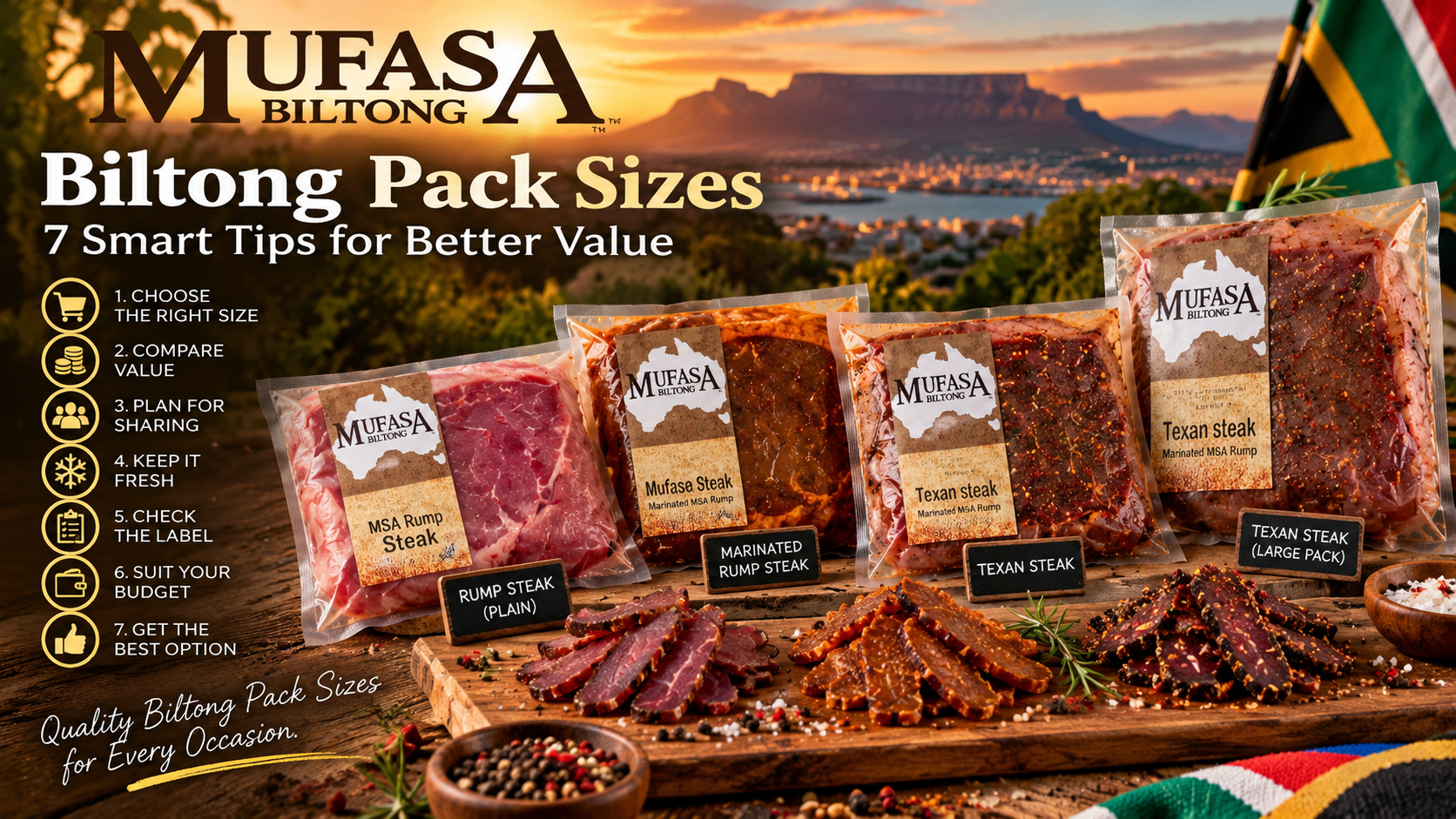
Choosing the right amount of biltong can make your next snack purchase easier and more practical. Whether you enjoy a few slices during the day, share biltong with family or like keeping a supply ready for entertaining, understanding biltong pack sizes can help you choose an option that suits your habits.
A larger packet is not automatically the best choice, just as a smaller packet is not always the most economical. The right option depends on how often you eat biltong, how quickly you use it, the price per gram and the storage instructions on the packaging.
In this guide, we explore seven useful tips for comparing biltong pack sizes. You will learn how to think about portions, compare value, plan for sharing and avoid buying more than you can comfortably use.
Why Biltong Pack Sizes Matter
Biltong is a convenient snack, but buying the right quantity still matters. A pack that suits one person who snacks occasionally may not be ideal for a household that enjoys biltong regularly.
Choosing suitable biltong pack sizes can also make it easier to plan shopping and serving. If you are preparing a snack board for guests, you may need a different quantity from what you would buy for everyday personal use.
Rather than choosing by packet appearance alone, consider the amount of product inside, the price, your expected use and the manufacturer’s storage guidance.
1. Think About How Often You Eat Biltong
Start by looking at your usual snacking routine. Do you enjoy biltong every day, once or twice a week, or mainly when friends and family visit?
Your answer can help narrow down the most practical pack option.
- Occasional snackers: A smaller pack may be easier to use without keeping a large quantity on hand.
- Regular snackers: A medium option may suit people who enjoy biltong throughout the week.
- Households and frequent sharers: A larger pack may be worth considering if the quantity will be used appropriately.
These are general shopping considerations, not fixed rules. Your preferred portion size and the product’s storage instructions should guide your decision.
When comparing biltong pack sizes, think about how much you realistically expect to eat before opening another packet. Buying according to your routine is often more useful than simply choosing the biggest option.
2. Compare the Price Per 100 Grams
One of the easiest ways to compare pack value is to calculate the price per 100 grams.
The total price of a packet does not tell you everything. A larger pack may cost more overall but offer a lower price per 100 grams. A smaller pack may have a lower checkout price but cost more for the same quantity.
Use this simple calculation:
Price per 100 g = (Packet price ÷ Packet weight in grams) × 100
For example:
| Pack | Price | Price per 100 g |
|---|---|---|
| 50 g | $5.00 | $10.00 |
| 100 g | $9.00 | $9.00 |
| 200 g | $16.00 | $8.00 |
Illustrative prices only, not current Mufasa Biltong prices.
In this example, the 200 g pack has the lowest price per 100 grams. However, it is only better value if you will use the quantity appropriately and are happy with the storage requirements.
This is why comparing biltong pack sizes by unit price is more useful than looking at the total price alone. Always compare products with the same currency, weight units and product type.
3. Choose a Pack That Matches Your Portion Habits
It helps to understand how you normally serve biltong. Some people enjoy a few pieces as a quick snack, while others add it to lunch boxes, grazing boards or shared platters.
Think about the occasions when you are most likely to eat it:
- A small snack between meals
- A savoury addition to lunch
- A snack to take when travelling
- A platter for family and friends
- A contribution to a picnic or casual gathering
If you mainly eat biltong on your own, a smaller quantity may be more convenient. If you regularly prepare food for several people, a larger amount could make serving easier.
There is no universal ideal portion or pack size. Appetite, product type and personal preferences all vary. Use the packet’s stated net weight to estimate how many servings you might get from it.
4. Consider Freshness and Storage Before Buying More
Buying a larger quantity can be convenient, but it is important to consider how the product should be stored once opened.
Different biltong products may have different packaging, ingredients and storage requirements. Always follow the instructions on the specific packet rather than assuming every product should be stored in the same way.
Before purchasing, check:
- The storage instructions
- The best-before or use-by information, where provided
- Whether the packaging is resealable
- Any instructions for after opening
- Whether the quantity is realistic for your household
A resealable packet can be convenient, but it does not replace the manufacturer’s storage directions.
When comparing biltong pack sizes, avoid buying a quantity simply because it appears to offer better value. Consider whether you can store and use the product as directed.
For general information about food safety, see Food Standards Australia New Zealand.
5. Plan Ahead for Sharing and Entertaining
If you are buying biltong for guests, think about the number of people attending and what else you plan to serve.
Biltong can be part of a larger snack spread alongside cheese, crackers, fruit, nuts, olives and dips. When there are several other foods available, you may not need as much biltong as you would for a biltong-focused tasting.
For a casual gathering, you could:
- Place a selection of biltong in the centre of a serving board.
- Add cheese and crackers for variety.
- Include grapes or sliced fruit for a fresh contrast.
- Offer nuts and olives in separate bowls.
- Keep extra product stored according to its packaging instructions until needed.
If biltong is the main attraction, you may want to allow for more than if it is one item among many.
Planning the menu first can help you choose between biltong pack sizes without guessing. For more inspiration, read our guide to what to serve with biltong.
6. Check the Weight, Ingredients and Product Type
Not all biltong products are identical. Different cuts, seasonings and formats can affect the way you enjoy them and how you plan to serve them.
Before comparing two packets, make sure you are looking at similar products. For example, comparing a pack of biltong slices with a pack of biltong sticks may not be a like-for-like comparison.
Check the following details:
Net weight: Look for the stated weight on the packet, rather than judging by its physical size.
Product style: Consider whether you want slices, sticks or another format.
Ingredients: Review the ingredient list if you have preferences or dietary requirements.
Allergen information: Read the label carefully, especially if the product is being served to guests.
Price: Compare the price per 100 grams when the products are sufficiently similar.
Food labels provide useful information about ingredients and other product details. You can find general guidance at Food Standards Australia New Zealand’s labelling information.
Taking a moment to check these details makes comparing biltong pack sizes more meaningful and helps you choose based on what you actually want.
7. Match Your Purchase to Your Budget and Routine
The best-value purchase is not necessarily the packet with the lowest unit price. It is the one that provides the quantity you want at a price that fits your budget and can be used in line with the product instructions.
A simple shopping plan can help:
- Decide how often you expect to eat biltong.
- Estimate how much you usually use.
- Compare the net weight of available packets.
- Calculate the price per 100 grams.
- Check storage and after-opening instructions.
- Choose a quantity that fits your budget and routine.
For example, a person who enjoys biltong occasionally may prefer a smaller purchase even if a larger packet has a lower price per 100 grams. Someone who regularly shares biltong with family may find a larger option more practical.
The goal is to make a considered choice rather than buying extra product simply because the packet looks like a bargain.
Common Mistakes to Avoid When Choosing Biltong Pack Sizes
A few simple mistakes can make it harder to compare products fairly.
Choosing by packet appearance: Packaging can make products look larger or smaller than expected. Check the net weight.
Looking only at the total price: A lower total price does not necessarily mean a lower cost per 100 grams.
Ignoring storage directions: A larger purchase needs to be stored according to the product’s instructions.
Comparing different product types: Slices, sticks and differently seasoned products may not be directly comparable.
Buying more than you need: A low unit price is not useful if the quantity does not suit your routine.
Avoiding these mistakes can make your next biltong purchase simpler and more satisfying.
Frequently Asked Questions About Biltong Pack Sizes
What biltong pack size should I buy?
Choose a quantity based on how often you eat biltong, how many people will share it and the storage instructions. Occasional snackers may prefer smaller quantities, while regular households may consider larger options.
Are larger biltong packs better value?
They can be, but not always. Compare the price per 100 grams and check that you can use and store the quantity appropriately.
How do I compare the value of different biltong packs?
Divide the packet price by its weight in grams, then multiply by 100. This gives you the price per 100 grams and makes it easier to compare similar products.
How much biltong do I need for a platter?
It depends on the number of guests and what else you are serving. If biltong is one of several snacks, you may need less than for a tasting where it is the main feature.
How should I store an opened biltong packet?
Follow the storage instructions on the specific product packaging. Requirements can vary, so do not assume that every biltong product should be stored in the same way.
Should I buy biltong in bulk?
Buying a larger quantity may suit regular consumers or households that share biltong frequently. Consider the unit price, your expected use and the storage guidance before deciding.
Choose the Right Biltong for Your Lifestyle
Finding the right quantity is about more than choosing the largest packet or the lowest total price. The most practical purchase fits your snacking habits, budget, serving plans and storage needs.
By comparing unit prices, checking product labels and thinking about how quickly you will use the product, you can make a more informed decision.
Explore the range at Mufasa Biltong and choose a biltong option that suits the way you enjoy this South African favourite.